| Weight | 0,1 kg |
|---|---|
| Dimensions | 15 × 21 cm |
| Pages | 16 |
| Binding | Saddle stitched |
| Illustrations | 14 in colour |
| Language | English, Italian |
| ISBN | 978-88-7461-566-7 italian, 978-88-7461-567-4 english |
| Year |
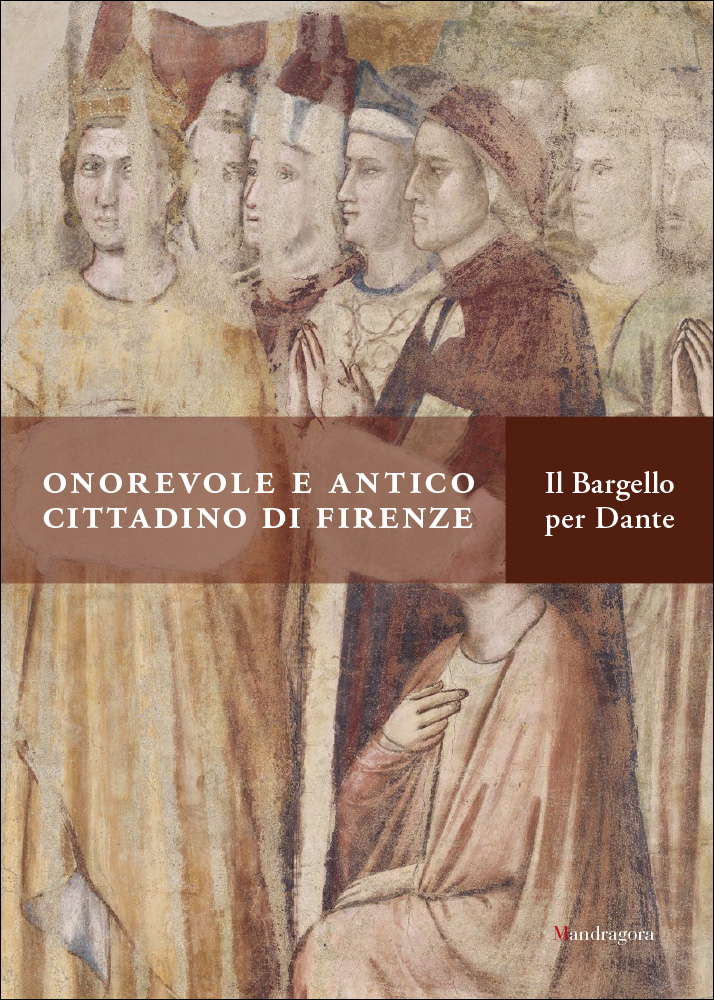
Short guide – «An Ancient and Honourable Citizen of Florence» The Bargello and Dante
Catalogues«An Ancient and Honorable Citizen of Florence» The Bargello and Dante
Short Guide
An agile guide summarizing the themes, works and highlights of the “Honorable and Ancient Citizen of Florence” exhibition. The Bargello per Dante, sponsored by the Comitato Nazionale per le Celebrazioni del 700° Anniversario della morte di Dante Alighieri, is the result of the inter-institutional
The Podestà Chapel, the last work painted by Giotto and completed by his workshop, is the starting point: the Poet is portrayed on the Paradise Wall, among the elect and with a branch of a tree in his hands. On the Hall wall, clear references to Dante’s work are depicted.
A guide to the history of the Divina Commedia, but also of its author, first convicted on the charge of misappropriation of funds and forced to die far from Florence, then protagonist in his city of numerous initiatives in view of rehabilitation: already starting from the end of the twenties, the Divina Commedia is replicated in a very high number of copies: a first in the medieval literature history. These copies were written by skilled hands and illustrated by excellent illuminators, such as Pacino di Bonaguida and the Master of the Dominican effigies.
Thanks to the choice of the “lingua volgare”, the reading of the poem was allowed to all those who, despite knowing how to read, did not know Latin. However, in order to understand the lines of the poem it was necessary to know the ancient stories it fed on and which it skillfully reinterpreted. Thus, in the first half of the fourteenth century, the first Florentine comments on the Commedia were born. This eased the path of the translation and printing of Latin and Greek works, opening a new dialogue between ancient and modern, while an ever wider audience became passionate about literature.
Eur 3,00
You may also like…
-
![]()
«An Ancient and Honourable Citizen of Florence» The Bargello and Dante
Catalogues This product has multiple variants. The options may be chosen on the product page Eur 70,00

Related products
-
![]()
Imaginary Creatures
Catalogues, Studies and Classical This product has multiple variants. The options may be chosen on the product page Eur 14,00 -
![]()
-
![]()
Pontormo and Rosso Fiorentino
Catalogues This product has multiple variants. The options may be chosen on the product page Eur 50,00
diverging paths of mannerism -
![]()